Kitora
What should be in an Australian workplace first aid kit?
Use Safe Work Australia’s Appendix E example and quantities as a starting point, then tailor kit contents and modules to workplace hazards.
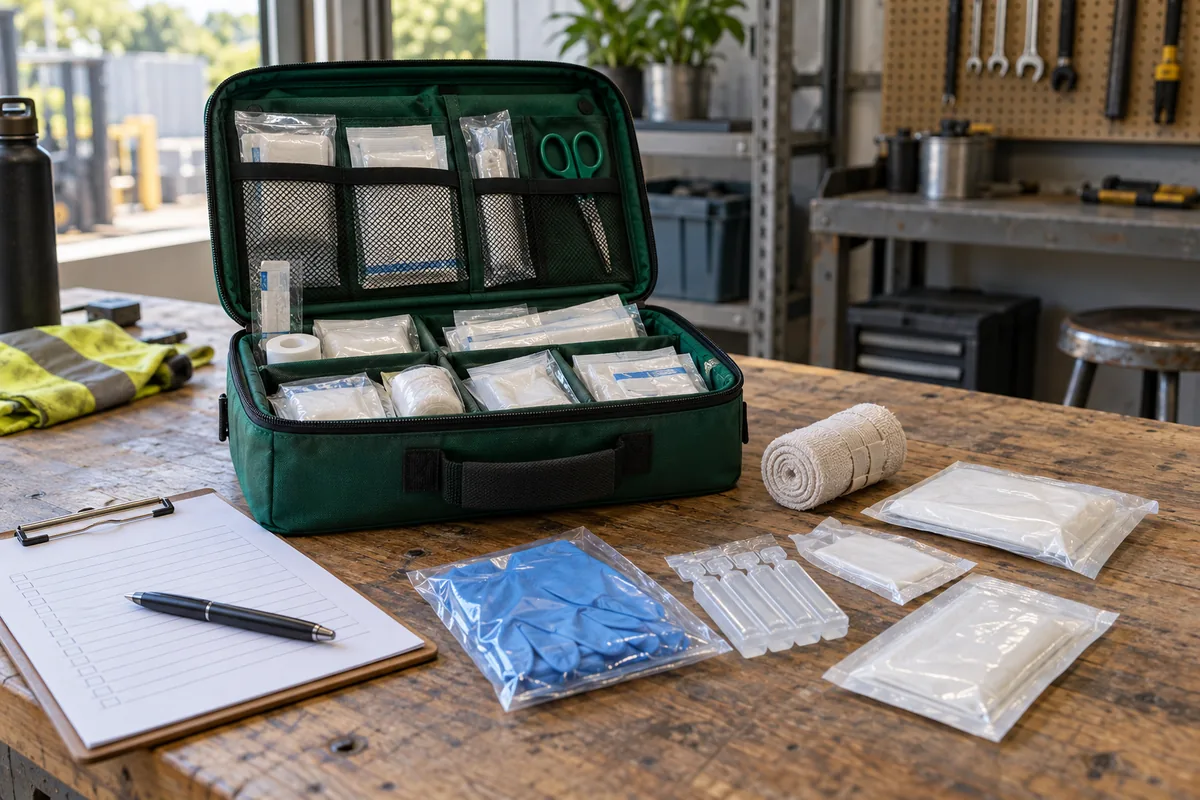
A typical workplace kit needs dressings, bandages, gloves, saline and a few basic tools. The table below shows the model Code’s example items and quantities.
Use the example as a starting point
The right supplies and amounts depend on the hazards, work areas, people on site and access to help. Use the model Code’s Appendix E as an example, then adjust the list for your workplace.
| Item | Example quantity |
|---|---|
| First aid instructions, including a CPR flow chart | 1 |
| Notebook and pen | 1 |
| Resuscitation face mask or face shield | 1 |
| Disposable nitrile examination gloves | 5 pairs |
| Sterile gauze pieces, 7.5 × 7.5 cm, 3 per pack | 5 packs |
| Saline, 15 mL | 8 |
| Single wound-cleaning wipes, 1% cetrimide BP | 10 |
| Adhesive dressing strips, packet of 50 | 1 packet |
| Single-use disposable splinter probes | 10 |
| Tweezers or forceps | 1 |
| Antiseptic liquid or spray, 50 mL | 1 |
| Non-adherent wound pads, 5 × 5 cm | 6 |
| Non-adherent wound pads, 7.5 × 10 cm | 3 |
| Non-adherent wound pads, 10 × 10 cm | 1 |
| Conforming cotton bandage, 5 cm wide | 3 |
| Conforming cotton bandage, 7.5 cm wide | 3 |
| Crepe bandage, 10 cm wide, for serious bleeding and pressure | 1 |
| Scissors | 1 |
| Non-stretch hypoallergenic adhesive tape, 2.5 cm wide | 1 roll |
| Safety pins, packet of 6 | 1 packet |
| BPC wound dressing No. 14, medium | 1 |
| BPC wound dressing No. 15, large | 1 |
| Combine pad, 9 × 20 cm | 1 |
| Clip-seal plastic bags | 1 |
| Calico or cotton triangular bandage, at least 90 cm wide | 2 |
| Emergency rescue blanket for shock or hypothermia | 1 |
| Single-use eye pads | 4 |
| Access to 20 minutes of clean running water; if unavailable, 3.5 g hydrogel sachets | 5 sachets if water is unavailable |
| Instant ice pack | 1 |
Add modules for specific risks
A module is an extra group of supplies for a particular risk, such as burns or remote work. Appendix E gives examples for outdoor, remote and burn risks:
- Outdoor work: where there is a risk of snake bites or insect or plant stings, assess whether to add a heavy-duty 10 cm crepe bandage and sting-relief cream, gel or spray.
- Remote work: the example module includes a heavy-duty 10 cm crepe bandage, large clean sheeting for burns, a thermal blanket, a whistle and a torch.
- Burn risks: the example includes two waterproof treatment instruction cards—one in the kit and one beside the emergency shower or water supply—eight 3.5 g hydrogel sachets, hydrogel dressings, clean polythene sheets in small, medium and large sizes, and a 7.5 cm cotton conforming bandage.
Some hazards need facilities as well as kit supplies. For example, a kit does not replace emergency eyewash equipment where the risk assessment identifies a need to flush hazardous chemicals or infectious material from the eyes.
Turn the example into your list
Walk the site with workers and note the likely injuries, who needs access and which separate facilities are needed. Set the contents and quantities for each kit, including any modules. Keep sterile products sealed and in date, protect supplies from dust and moisture, and make the list easy to check.
Use the workplace kit checklist to count what is stocked, then compare the result with the list chosen for each work area. For kit numbers and placement, read how many kits a workplace needs and where to locate them. For medicines, see which supplies belong in a workplace kit.