Free community workshop guide
First aid kit checks in a community workshop
Check the real kit, record what changed, assign the follow-up and leave the next person a clear handover.
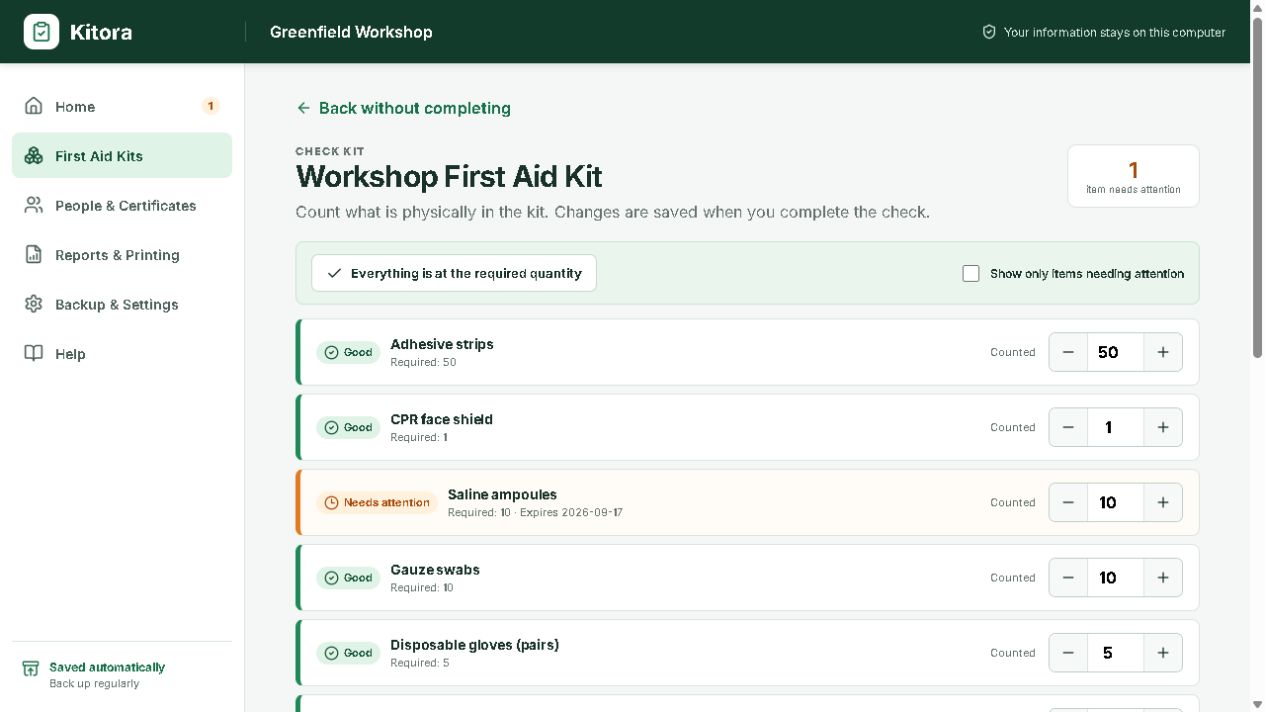
Start at the cupboard, cabinet, vehicle or portable kit people actually use.
Start with the work, not a generic checklist
A community workshop may have machinery, sharp tools, chemicals, hot work, visitors, volunteers, contractors, vehicles or separate work areas. Use the workplace risk assessment and current contents list to decide what belongs in each kit; use the inspection record to show what was actually found.
Keep the boundary clear: this guide helps organise a kit check. It does not set workshop contents, replace a risk assessment, give treatment instructions or guarantee compliance. Confirm the requirements and regulator guidance applying in your jurisdiction.
Three useful questions for the workshop round
01 / Find it
Can people get to the kit quickly?
Record the kit name and location clearly, especially when the workshop has separate rooms, storage areas, vehicles or portable kits.
02 / Check it
What changed since the last round?
Note used, missing, damaged, opened or expired items while the kit is open, rather than relying on memory after the check.
03 / Hand over
Who owns the next action?
Give the follow-up an owner, due date and completion note so the next person can see what is still open.
Choose the record that matches the job
A kit inspection record is not the same thing as a first-aider training register or an incident and injury record. Keeping those purposes separate makes each handover clearer.
Physical kit
Inspection record
Use this for the kit location, contents, condition, checker, action owner and next check.
People and training
First aider register
Use the separate register for people, providers, certificate numbers, issue dates and renewal dates.
A compact handover field list
| Field | What the next person needs |
|---|---|
| Kit and location | Which kit was checked and where to find it |
| Date and checker | When the check happened and who did it |
| Result and exception | What was good, missing, damaged, opened or expired |
| Action owner and due date | Who will follow up and when |
| Closure and next check | What was completed and when to look again |
For a ready-to-print contents sheet, use the workplace first aid kit checklist.
Incident or injury records are a separate process. Do not add personal medical histories to a routine stock record just because a kit was opened; follow the incident-reporting and privacy process that applies to your workplace.
Before you close the cupboard
- Confirm the kit is clearly identified, accessible and still in its recorded location
- Compare the contents with the workplace’s current list, not a remembered or generic list
- Record used, missing, damaged, opened or expired items while the kit is open
- Give every unresolved item an owner, due date and any interim action needed
- Record when the action is closed and set the next planned or trigger-based check
- Tell the relevant coordinator, shift or workshop lead about anything that remains open
Keep the record proportionate
A routine kit record can stay short: workplace, kit and location, date, checker, result, items needing attention, action owner, closure and next check. Keep personal medical and incident details in the separate controlled process that applies to your workplace.
For item-level checks, use the workplace checklist. The inspection-record guide explains findings and follow-up. If repeated paper checks are becoming difficult to maintain, download Kitora free to keep the history offline.
For Australian workplace context, see Safe Work Australia’s first aid guidance and the model Code of Practice. Check your state or territory regulator for requirements applying to your workplace.